There is one critically important component almost universally on the minds of focus area developers data security. With more and more attacks in volume and
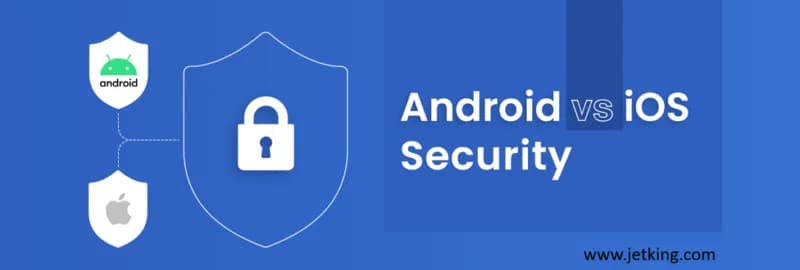
Introduction When smart phones, i.e., comparing IOS and Android, is concerned, it is an eternal game. While both OS offer a set of capabilities, and within that set, there is one critically important component almost universally on the minds of focus area developer’s data security.
With more and more attacks in volume and rate, it is more or less critical that the private and personal financial info is safe. Right, but, how does iOS fare back against Android when the security, for instance, is "in the eye of the beholder? Let us dive in. Understanding Data Security in Smartphones
Why Data Security Matters Think about the amount of sensitive information stored on your smartphone banking details, emails, photos, and even health records. A security breach has the potential consequence of identity theft, loss of money, worst scenario. Hence, data security is at least one of the topics that any mobile phone user will be thinking about.
Data Breaches and Their Impact Data breaches are more common than you think. Leaked passwords toileted and/or direct access to personal data can be very harmful.
Specifically, as an example, it has been demonstrated that Android-powered devices are behind numerous high-profile breaches caused by the hardware of the devices. iOS Security: What Sets It Apart Apple’s Closed Ecosystem Closed nature of an iOS ecosystem is one of its capabilities.
On the other side, in contrast to Android (open source software), Apple strictly manages both the hardware and software. This, as a result, minimizes the number of potential attack vectors and lowers the risk that the system will be compromised and/or exploited (oral version of this sentence).
Strict App Store Regulations Notwithstanding the fact that Apple's substantially visible review process in the App Store allows Apple to portray a positive view of a rigorous selection process during the app placing stage until app insertion into its ecosystem, the authenticity of the reflection seems to be a pending issue for future research.
All apps have been subjected to checks to ensure that they meet security standards. This will dramatically reduce the risk that such insidious applications will be installed on iOS devices, whereas they will be much more easily detected on the Google Play Store on Android devices, where malware is much more common.
Regular Software Updates Apple takes software updates seriously. IOS users are given regular updates to deal with security holes and to harden the security of their devices. On the other hand, security patches for Android are often delayed by device side fragmentation and end users are left vulnerable to the attack.
Android Security: The Challenges Open-Source Nature Although as an open-source platform of Android is expandable on the aspects of security, it is security insecure. There is leeway for change from developers, but along with that, discretion comes a possibility of higher vulnerability (e.g., easy prey for malware attacks) of Androids.
Fragmentation in Updates Android’s biggest weakness is its fragmented update system. In contrast to the iOS, where updates are rolled out everywhere, in Android updates are controlled by the device manufacturers, hence can be notorious for being slow, and lacking in terms of security updates. Third-Party App Stores Android allows users to install apps from third-party sources.
It is, however, the case that regardless of the increase in the number of possibilities, it may function as a vessel for introducing the malware in the form of possible malware, in that it opens up the possibility of security breaches. Privacy Features Comparison: iOS vs. Android iOS Privacy Features Apple has been a pioneer in privacy.
Permissions controls (e.g., App Tracking Transparency and special permissions) allow the ultimate user more control over how their personal data is used. Android Privacy Features Yet, in recent years, android has fallen behind in privacy-limited features alone, such as one-way permission, and even, ios has lagged in privacy-limited general abilities.
Data Encryption: Who Does It Better? End-to-End Encryption in iOS Encryption protocols are very secure in iOS, and communications data is kept private in transit. End-to-end encryption is also provided at the basis level for apps (e.g., iMessage, FaceTime). Android Encryption Challenges While Android also supports encryption, it varies across devices.
For models/mod(s), i.e., specially old models/mod(s), designed by an unrelated person, the tendency to reveal the encryption, a crucial security leak, to the user is there. Real-World Examples: iOS vs. Android Security Case Studies of Data Breaches Several incidents have highlighted the superior security of iOS.
As an example, a large number of high-profile exploits focused on Android devices because of their susceptibility, whereas exploits focusing on iOS devices have been relatively few. User Trust and Brand Reputation In longitudinal and repeated questionings, respondents report They believe that Apple (i.e., company) is the most trustworthy data security provider.
In this trust, the intention of the company 'associated will' to privacy protect user data is realized. The Role of Hardware in Data Security IPhone’s Secure Enclave Apple’s Secure Enclave is a game-changer.
There is this hardware-oriented security device, in which extremely confidential information (e.g., biometric data) is distributed, in such a way that it makes the attack practically impossible to discover. Android’s Hardware Challenges Android devices vary widely in hardware quality. This difference reduces the importance of security mechanisms and the number of attacks.
Read this also: Difference between Ethical Hacking and Penetration Testing User Experience and Security Balancing Convenience and Safety IOS offered a good balance between ease of use and security level. Background knowledge and sequential decryptions (e.g., are acquired in an implicit way and as such they are both simple and safe to incorporate).
Conclusion In the context of data security, iOS outdoes Android. Safety is at the heart of Apple, from the closed ecosystem to deep encryption, to privacy technologies. Even with all its benefits, the security of Android has not been 100% secure. Choosing a cellular telephone is not just about specifications, but also about digital life security.